NN Marathon Rotterdam 2027: the ultimate guide
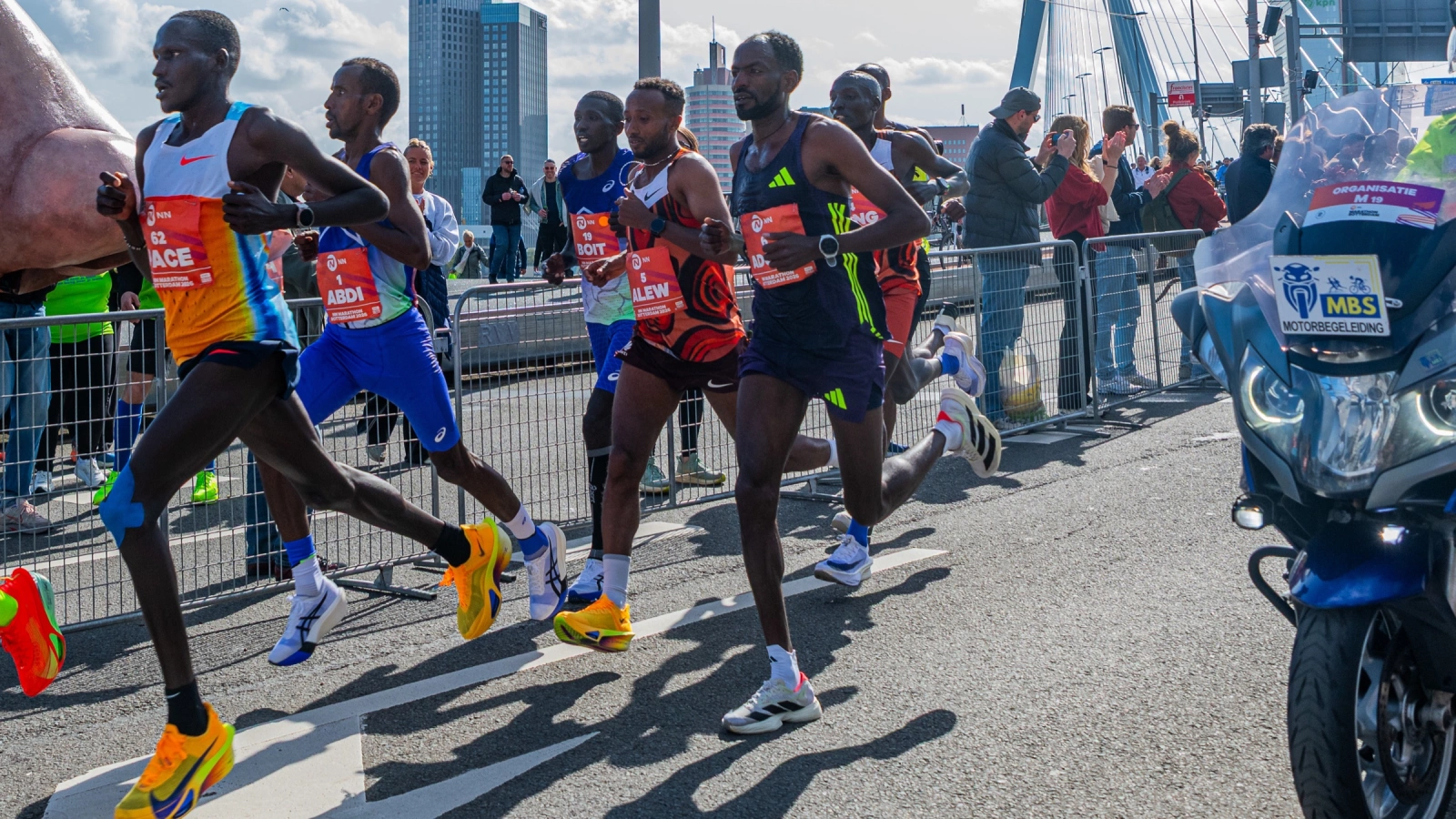
On Sunday 11 April 2027, the 46th NN Marathon Rotterdam is on the calendar. Entries go on sale on 4 November 2026, and for the first time in years there is no ballot: whoever is quickest gets to run. In this guide you'll find everything you need to know: how to get a race entry, how the course is put together, what to expect from the weather and what I would do differently myself after four editions on the Coolsingel.
Why Rotterdam
Rotterdam calls itself #demooiste ("the most beautiful one") and for once a hashtag is no exaggeration. This is the biggest marathon in the Netherlands, one of the fastest in the world and above all a city that revolves entirely around the runners for a whole day. The organisers count around 950,000 spectators along the course. Whether that figure is exactly right, nobody knows, but anyone who has ever run across the Erasmusbrug (Erasmusbrug) while the entire bridge is cheering no longer doubts it.
Then there's the start. Just before ten o'clock it goes quiet on the Schiedamsedijk and someone sings "You'll Never Walk Alone". For years that was Lee Towers; in 2026 Berget Lewis took over. Eighteen thousand people softly singing along and then the starting gun: no marathon in the Netherlands begins like this.
And it's fast. Carlos Lopes set a world record here in 1985, Belayneh Dinsamo in 1988, Tegla Loroupe in 1998. Bashir Abdi's course record (2:03:36 from 2021) is still the European record. The course is flat, the corners are wide and the crowds drag you through the final kilometres. My own times speak for themselves: 4:37 in 2022, 3:44 in 2024, 3:38 in 2025 and 3:29 in 2026. All four on this course, and yes, that last one was the most beautiful.
The facts at a glance
| Date | Sunday 11 April 2027 (46th edition) |
| Start | 10:00 on the Schiedamsedijk, at the foot of the Erasmusbrug; start waves leave until around 10:40 |
| Finish | Coolsingel |
| Distance | 42.195 km, certified by the Atletiekunie, the Dutch athletics federation |
| Participants | 18,000 in the marathon (the city council does not allow any growth); over 50,000 across the whole weekend |
| Time limit | 5 hours and 30 minutes |
| Price | EUR 155; Rotterdam residents under 24 pay EUR 116 |
| Included | Race number with your name (if you register before 1 March), Asics running shirt, medal, chip timing |
| Pacers | NN Pacing Team from 3:00 to 5:00, three pacers per group, free |
| Registration | Wednesday 4 November 2026, first come, first served |
How to get a race entry
This is the part that really changes in 2027. In recent years there was a ballot: in 2026, around 50,000 people applied for 18,000 places. That system has been scrapped. Anyone who pre-registered for free before 3 November 2026 receives a personal registration link, and from there it's first come, first served on Wednesday 4 November.
Here's how the day itself works:
- 3 November, by 17:00 at the latest: your personal link arrives by email. No pre-registration means no link, and no link means no entry.
- 4 November, 10:00: the link opens for everyone who missed out in the 2026 ballot. Half of the race entries are reserved for this group. The five euros you paid for the 2026 ballot is automatically deducted from the entry fee.
- 4 November, 14:00: the link opens for all other pre-registrants. If the entries reserved for the morning haven't all gone, they roll over into this round.
- Registration closes automatically once everything is sold out. After that, an official waiting list opens.
My advice: be ready and waiting. Set an alarm for 09:55 or 13:55, log in to your account beforehand, put your bank card next to your laptop and fill in the form in one go. The expected finish time you enter determines your start wave and you can't change that choice later, so decide in advance what you want to put down. Torn between two times? Choose the faster one: dropping back to a pacing group behind you is always possible on the day, moving forward is not.
Fast enough for a free entry? Men under 2:25 and women under 2:53 (run after 1 April 2026) can apply for a fast runners' entry, with their own start pen directly behind the elite. And for those who prefer to run for a good cause: raise at least EUR 750 for KWF, the Dutch Cancer Society, and KWF gives you an entry and a shirt. In 2026, around 2,600 people ran for KWF.
The course, kilometre by kilometre
The organisers will publish the final 2027 course in the spring. There's a good chance it will closely resemble the 2026 course, as that one had only just been redesigned. This is what it looked like then.
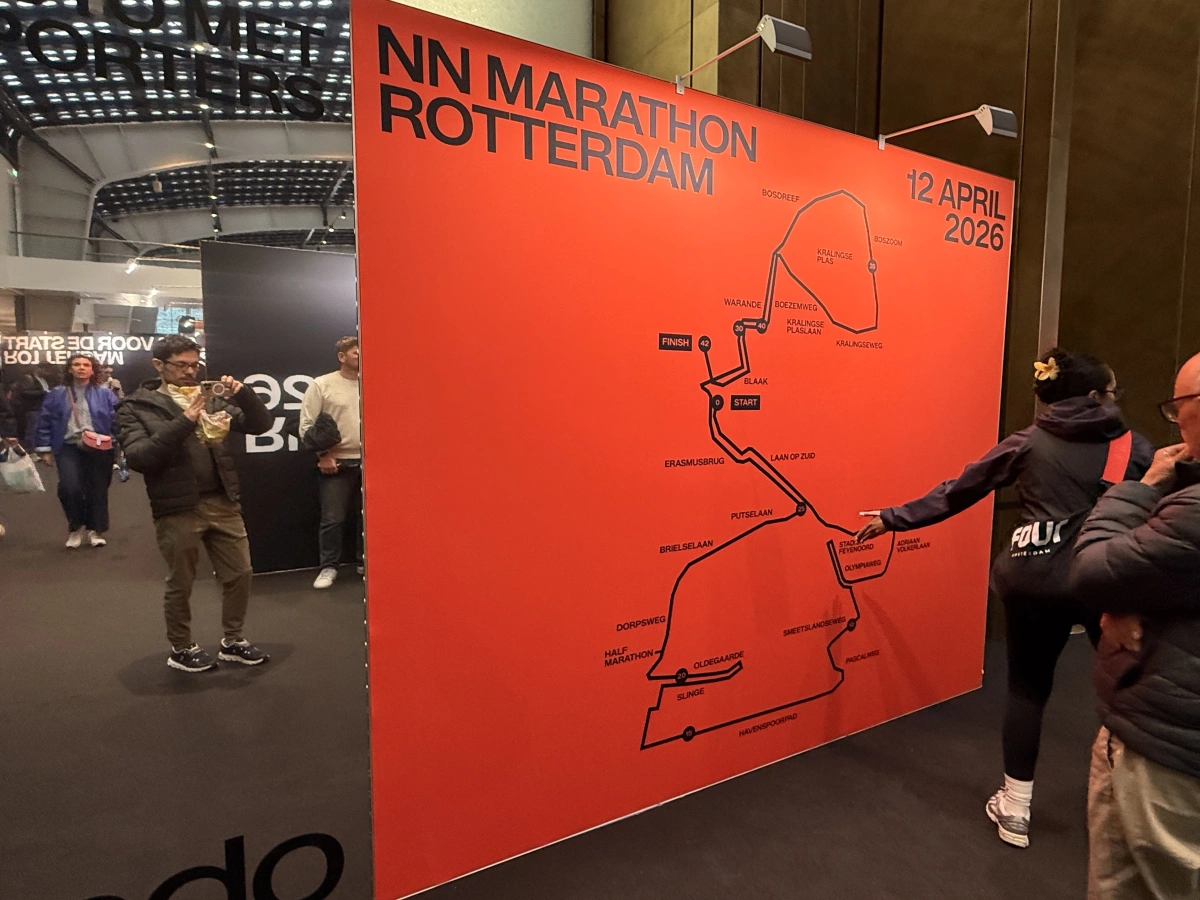
Kilometre 0 to 5: the Erasmusbrug. You start on the Schiedamsedijk and within a kilometre you're running up the Erasmusbrug. It's the only real climb of the day, a few metres of ascent over a few hundred metres, and you don't feel it because the whole bridge is packed with people. On the other side, the Kop van Zuid and the Laan op Zuid await: wide, flat and still full of spectators.
Kilometre 5 to 13: De Kuip. Via the Putselaan you head towards Feijenoord. Since 2026 you pass De Kuip twice between kilometres 7 and 11, with a wide loop in front of the stadium. Here the crowd stands right up against the road and it sounds as if a home match is under way. Enjoy it, but keep an eye on your pace. This is the stretch where adrenaline has you running ten seconds per kilometre too fast.
Kilometre 13 to 24: Rotterdam-Zuid. Olympiaweg, Smeetslandseweg, Pascalweg, Havenspoorpad, Slinge and then twice along the Oldegaarde around the 20-kilometre mark. This is the quietest part of the course. Long straight roads, fewer spectators, and at 20 km the Chiquita zone with bananas and high fives. This is where the race is made or broken: hold your pace here and you'll still have legs later on.
Kilometre 24 to 30: back over the bridge. Via the Dorpsweg and the Brielselaan you return to the Putselaan and then head up the Erasmusbrug again, this time towards the city centre. The second time, the bridge feels longer than the first. Then the Blaak, the centre, and at kilometre 30 the real work begins.
Kilometre 30 to 37: the Kralingse Plas. Along the Kralingse Plaslaan and the Boezemweg you run a loop around the Kralingse Plas and through the Kralingse Bos. Beautiful, but notorious. This is where the wall awaits. The crowds are thinner here, the road is long and straight and your head starts doing sums. The organisers know it too: at 34 km there are four big screens showing personal video messages (the NN Hardloopsupporter: your family can submit a clip in advance), at 35 km Upfront hands out gels and at 36 km there's the KWF cheering zone with a DJ.
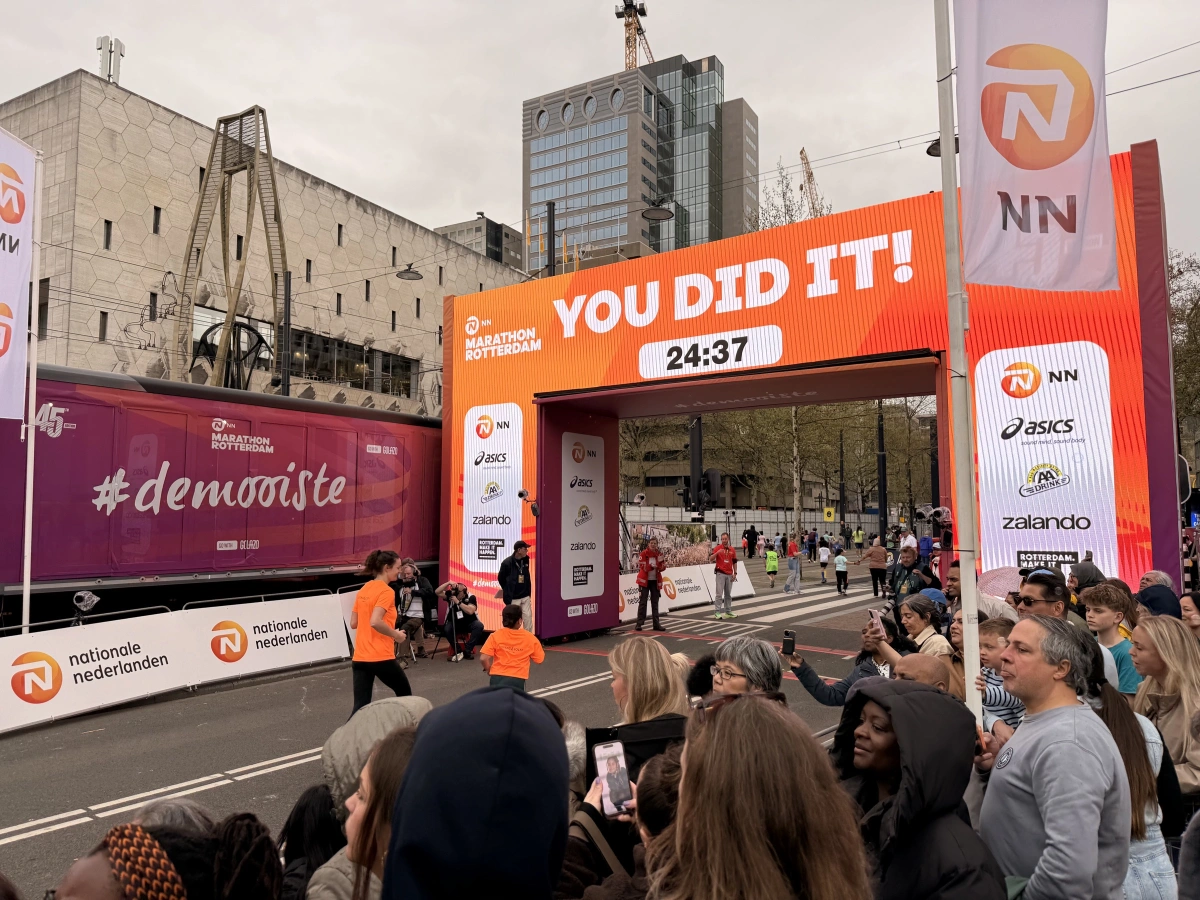
Kilometre 37 to 42: the Coolsingel. Back via Crooswijk, where the pavements are packed again, and then up the Warande to the Coolsingel. The final stretch is a dead-straight boulevard with grandstands, an announcer calling your name and a finish arch that reads "You did it". In 2026, because of roadworks on the Hofplein, the finish was at the WTC, a few hundred metres before the usual spot at the City Hall. Where it will be in 2027 is yet to be announced.
The elevation is negligible: around 75 metres of climbing over the entire distance, most of it the two crossings of the Erasmusbrug. There are aid stations every five kilometres (5, 10, 15, 20, 25, 30, 35 and 40 km) with water and AA Drink Iso-Lemon, plus the gel station at 35 km. Bring your own gels if you have a brand you're used to; relying on what you're handed along the way is rarely a good idea in a marathon.
The weekend: expo, race number and bag drop
The marathon weekend starts on Friday with the Marathon Sport Expo in the Postillion Convention Centre WTC Rotterdam, right in the middle of the Coolsingel. That's where you collect your race number; in 2026 you could do so on Friday from 10:00 to 20:00 and on Saturday from 10:00 to 19:00. Race numbers are not posted out. Bring your confirmation email and allow a quarter of an hour; the queue moves quickly.
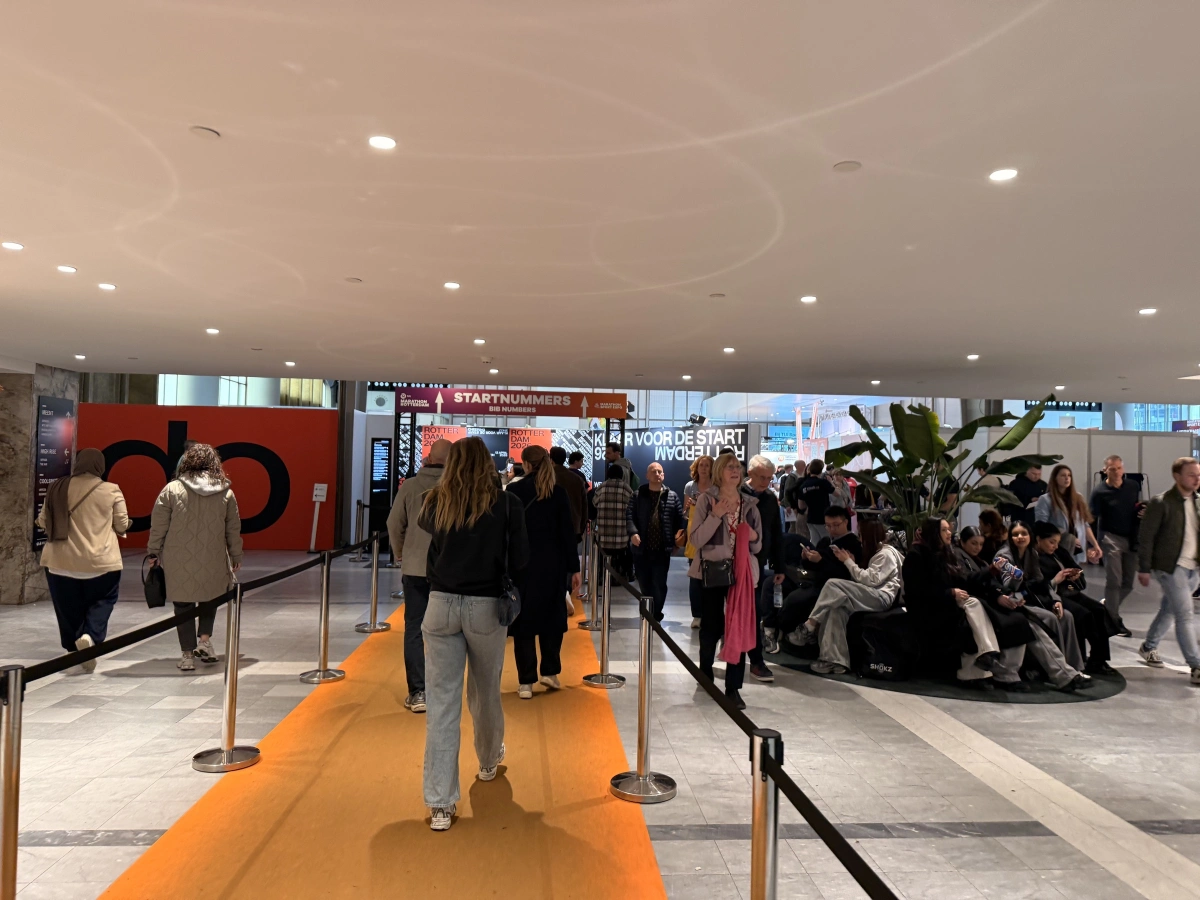
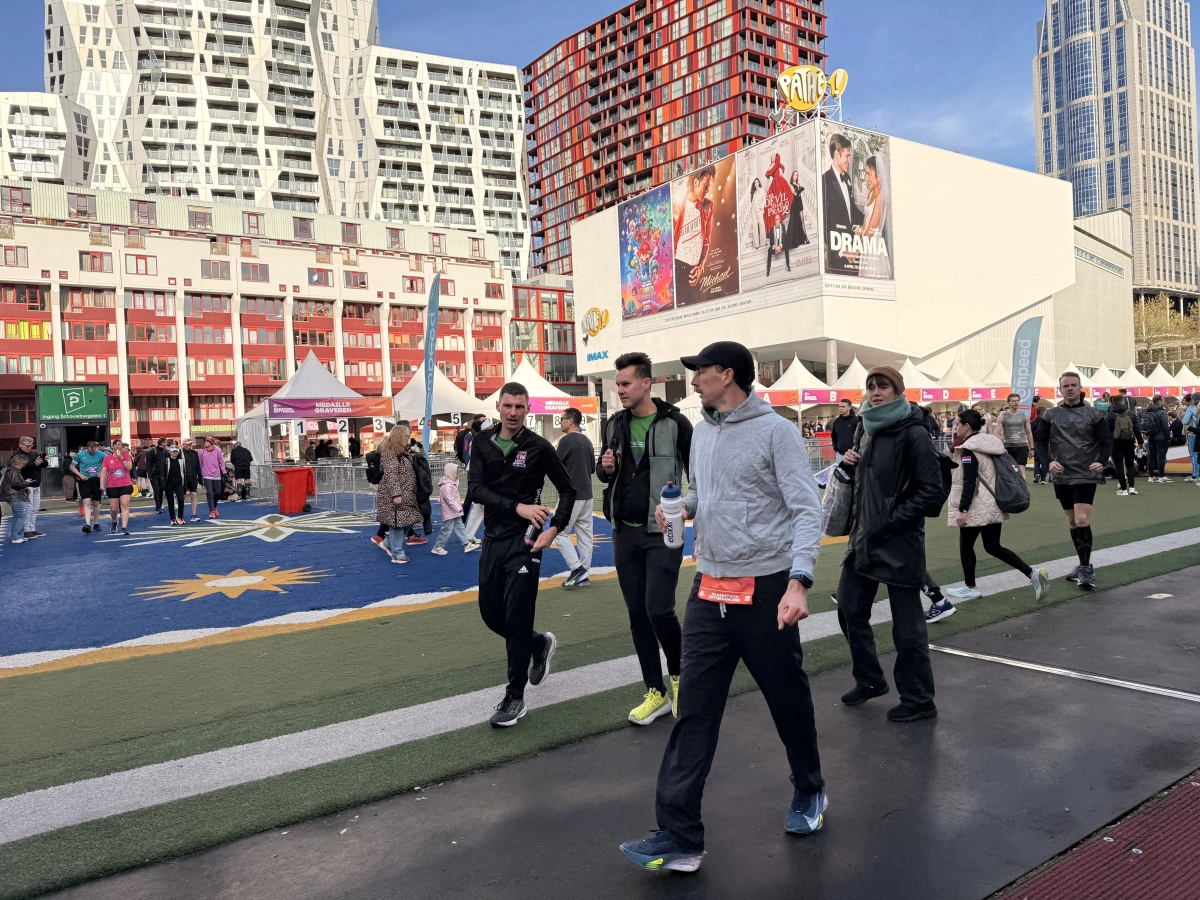
The expo itself is big: Asics as kit partner, the major brands, stands with gels and socks and a stage with talks. My tip is to go on Friday. Saturday is busier, and the day before a marathon you don't want to spend three hours on your feet between the stands.
Your entry includes a limited edition Asics shirt. In 2026 it was a blue shirt with the map of Rotterdam and the course drawn on it, and the course was reflective. It's a shirt you actually wear afterwards, which is not a given with marathon shirts.
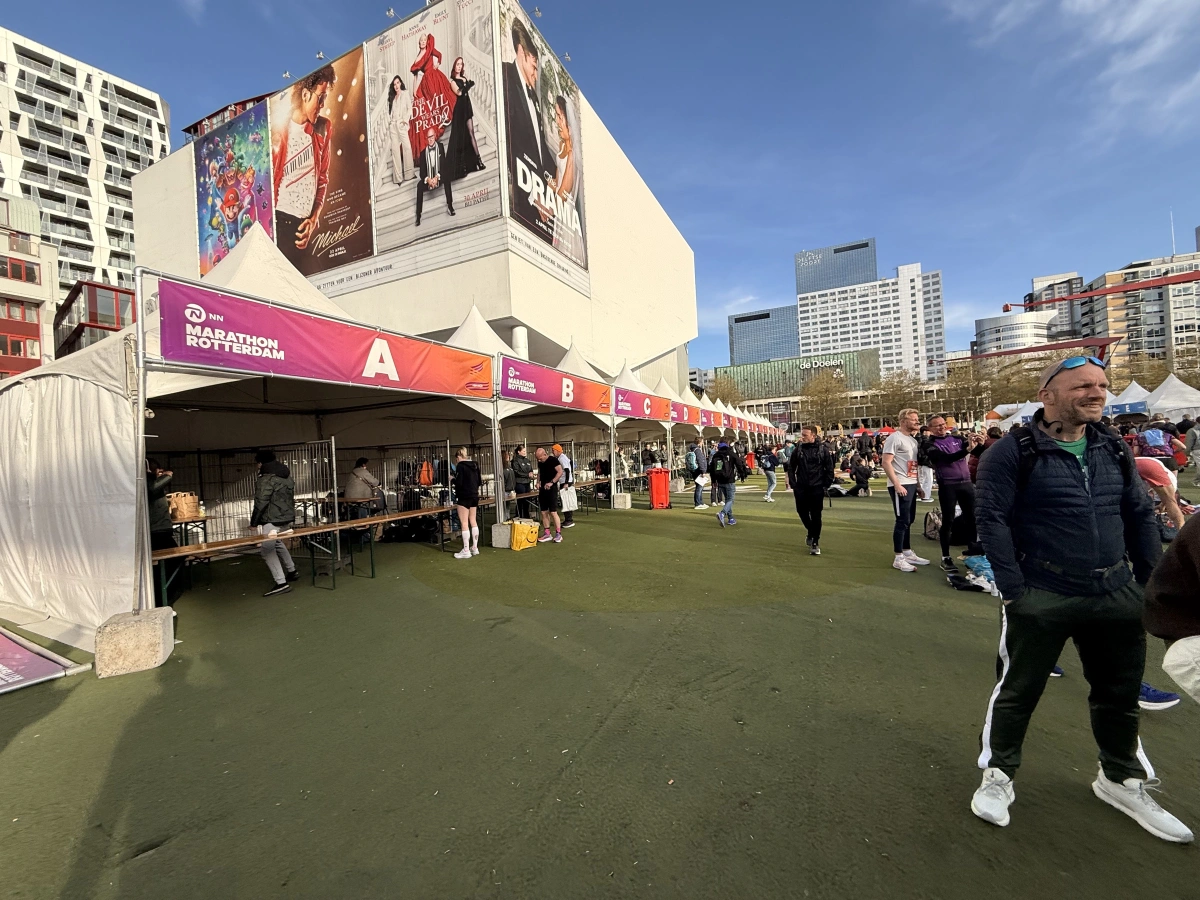
On Sunday morning you hand in your bag at the bag drop on the Schouwburgplein, arranged by letter. That's a few minutes' walk from both the start and the finish, so you don't have far to go on stiff legs afterwards. On the same square you'll find the meeting point flags in blue, green, red and yellow: agree a colour with your supporters in advance, because nobody is allowed into the finish area itself and with 18,000 finishers you won't find each other otherwise.
A nice extra from 2026: your race entry got you into the Kunsthal for free all weekend. Whether that returns in 2027 isn't known, but it's worth checking.
More than the marathon
The weekend has over 50,000 participants and the marathon is only part of that. On Saturday the Marathon Rotterdam Walk (5, 10 or 15 km) starts on the Coolsingel, followed by Your Marathon Challenge (run 41 km in the weeks beforehand, then the final 1.195 km together on the Coolsingel), the NN Kids Runs of 1 and 2.5 km (EUR 4, with 1,100 free places for Rotterdam primary school pupils) and the City Run of 4.2 km. On Sunday at 09:15 the 10 km Rotterdam starts at the Markthal, with around 17,000 runners circling the Kralingse Plas, three quarters of an hour before the marathon.
That also means: bring your partner or your kids. There's something for everyone to run, and whoever does the City Run on Saturday will be standing along the course on Sunday with a medal around their neck.
The weather in April
Rotterdam in April is a gamble that usually pays off. According to the KNMI, the Dutch meteorological institute, conditions here are ideal for a marathon in around sixty per cent of years, compared with forty per cent for Amsterdam in October. Ideal means a perceived temperature (WBGT) between 5 and 13 degrees, and a Rotterdam April morning usually falls within that range.
But there are outliers too. In 2026 it was around ten degrees at the start, dry and windy, with a headwind over the final kilometres. In 2025 it was 14 degrees with high humidity, more oppressive than it sounded. In 2018 it climbed to 20 degrees. And in 2007 the race was stopped after three and a half hours at 34 degrees, the most notorious edition in its history.
What I take from that: train a few times in the weeks beforehand in the kit you want to wear on the day, bring an old jumper or a bin bag for the start pen (you can easily stand there for half an hour), and check the wind on Saturday. A south-westerly means a tailwind on Zuid and a headwind in Kralingen, exactly when you don't want one.
Travel, accommodation and supporters
By train, Rotterdam is the easiest marathon in the Netherlands. Rotterdam Centraal is a ten-minute walk from the start, and the Beurs and Blaak metro stations are practically on top of it. Coming from abroad, Rotterdam Centraal has direct Eurostar trains from London, Brussels and Paris, and ICE connections from Germany. If you fly, Rotterdam The Hague Airport is small and close by, and Schiphol is about 25 minutes by train from Rotterdam Centraal. Note: on marathon Sunday, no metros stop at Leuvehaven until 15:00 or at Stadhuis until 19:00. Expect crowds at Beurs and Wilhelminaplein, where there are waiting zones.
By car is, frankly, a bad idea. The city centre is closed off, the car parks at the WTC, Beursplein, Meent and Markthal are inaccessible and the organisers direct you to the P+R sites on the edge of the city. From there, take the metro in.
Accommodation: Rotterdam's hotels are over 95 per cent full on marathon weekend. Book on 4 November, straight after registering, and choose something in the centre so you can walk to the start on Sunday morning.
For supporters, the course is rewarding. From the Churchillplein (next to Beurs metro station) marked routes lead to the Erasmusbrug, where you see the runners twice: around kilometre 1 and around kilometre 27. At De Kuip and on the Oldegaarde they also pass twice. The Kralingse Plas is the point where they need you most. You can cross the course via the Koopgoot, under the Cube Houses (Kubuswoningen) and at Oostplein metro station; on Sunday there's a footbridge over the Churchillplein. The official app sends push notifications with split times and shows where your runner is.
My tips after four Rotterdams
- Start easy on Zuid. The first ten kilometres are a party and that party tempts you. Every second you run too fast there, you pay back double in the Kralingse Bos.
- Join a pacing group if you're chasing a time, but have a plan B. Three pacers per group, from 3:00 to 5:00, and they run remarkably evenly. In a group you're sheltered from the wind and you don't have to do the maths. Two caveats: the popular groups (3:30, 3:45, 4:00) are crowded, sometimes so crowded that you have to squeeze your way to the drinks stations, and in the crush around the start the flags are hard to find. So look for your pacers while you're still in the start pen, and if that doesn't work, run your own pace using the kilometre splits on your watch and latch on later when the group catches you or you catch it. A pacer is a tool, not your plan.
- Eat early and often. From kilometre 8, a gel every 25 to 30 minutes. Don't wait until you feel hungry; by then you're too late. The gel station at 35 km is a bonus, not a plan.
- Know the Kralingse Plas before you get there. Visualise this stretch in the weeks beforehand: you run from the busy city into a quiet wood, the crowds thin out, the road is long and straight and it goes silent around you. This is where most PBs die. Make it your strength: pick a runner ahead of you, reel them in gradually and move on to the next one. Keep an eye on your kilometre splits, because the pace drops here without you noticing. And know that the screens at 34 km and the DJ at 36 km are coming.
- Save something for the Coolsingel. The final 800 metres are the finest stretch of running in the Netherlands. It would be a shame to walk them. And smile at the photographer just before the finish, before you stop your Strava.
- Sort out your supporters. Agree very precisely where they'll stand, including which side of the road. The crowd is several rows deep and it's easy to look straight past someone. They can follow your split times in the official app, but that app has its moments, so also agree a time window in which to expect you. On top of that: a colour on the Schouwburgplein for after the finish, a spot on the bridge at kilometre 27 and a video for the screen at 34 km. It sounds corny, until you experience it yourself.
- Stick around for a while. The prize ceremony on the stage at the WTC, the Chocomel on the Schouwburgplein, the city slowly opening up again. Rotterdam after the marathon is a city full of people wearing a medal, and that's a feeling you don't get every day.
A bit of history
The first Marathon Rotterdam was run on 23 May 1981, in the rain, with around 200 participants. Scotsman John Graham won in 2:09:28 and received 750 pounds for it. The race has been held in April since 1984.
In 1985 Carlos Lopes, 38 years old and reigning Olympic champion, ran 2:07:12 here: Rotterdam's first world record. Belayneh Dinsamo did it again in 1988 with 2:06:50, a record that stood for ten years. Tegla Loroupe set the women's world record at 2:20:47 in 1998. That same day Fabián Roncero was on world record pace until he cramped up on the Maasboulevard; he lost the record and a bonus of 150,000 euros.
The course record has belonged to Bashir Abdi since 2021 (2:03:36, still the European record). Dutch runner Abdi Nageeye won in 2022 and 2024 and set the Dutch record here in 2019. In 2026 Mekides Shimeles, aged 20, improved the women's course record to 2:18:56, two seconds under Tiki Gelana's record from 2012. In the men's race Guye Adola won in 2:03:54, after Abdi, on his way to a third victory, was forced to walk with cramp at kilometre 38. The Dutch titles went to Filmon Tesfu (2:06:40) and Mikky Keetels (2:30:42), both in personal bests.
At the foot of the Erasmusbrug stands the Marathon Statue by Henk Visch. The plinth lists every winner, men and women, since 1981. Walk past it once you've picked up your race number. It helps you realise what you'll be running through the following day.
Finally
Rotterdam is the marathon I come back to every year, and I'm not the only one: half of the 2027 entries are reserved for people who couldn't be there in 2026. Make sure you're ready on 4 November, book a hotel that same day, and start training on Monday. See you on the Coolsingel.

Run the NN Marathon Rotterdam on 10-11 Apr 2027 in Rotterdam, Zuid-Holland, Netherlands! For more information, check out the official website.